Frontier · Sub-page
Contribute — record well, submit honestly.
The proper upload pipeline lands in v3. Until then: email plus a Google Form. Low-fi, but the constraint encodes selection for serious submissions.
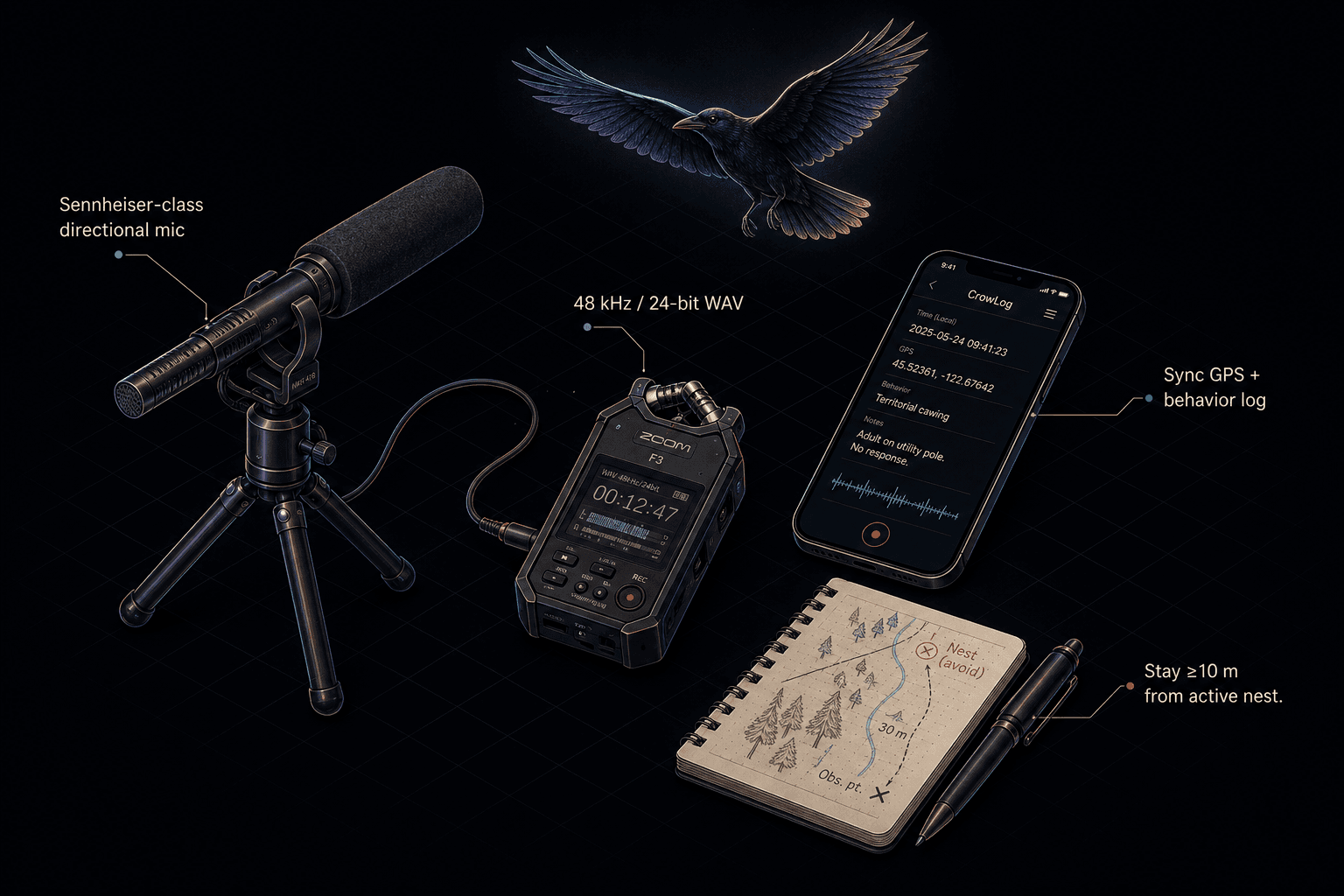
IG · 07 · FIELD · RIG
The minimum viable rig — directional shotgun mic, field recorder, behavior-log phone. ≥10 m from active nests. Detailed walk-through on /pipeline/record.What a usable submission looks like
- Audio:48 kHz / 24-bit (or close), mono, lossless WAV preferred (or FLAC). MP3 acceptable but loses spectral resolution we'd rather not lose.
- Length:the full take, not pre-trimmed. Silence and ambient noise help calibration; don't edit them out.
- Behavior log: a CSV or short text file with timestamps and observed behaviors. See the schema on the Record stage page.
- Location:city level only, please. Don't send precise GPS — we'll coarsen it on intake but accidental over-share is a recurring issue.
- License: you must own the recording (or have it from a CC-BY/CC-BY-NC source). Submission grants CrowLingo non-exclusive rights to redistribute under CC-BY-NC.
How to submit (v0)
Two options, in order of preference:
- Email contact@kymatalabs.com with the audio attached or a Drive/Dropbox link. Include the behavior log in the body. We reply within two weeks.
- Fill the intake Google Form (link in the v0 announcement post; placeholder while we vet license language). Same metadata, structured fields.
What we do with your submission
- License + metadata sanity check.
- Location coarsening to city level.
- Behavior log normalization to the standard schema.
- Reference embedding extraction with NatureLM-audio (so the call gets a coord in the public atlas).
- Cluster assignment + cluster-context probabilities computed.
- If accepted: included in the next dataset release (v2+) with attribution.
What disqualifies a submission
- Recordings made near active nests in breeding season.
- Recordings where a playback experiment violated the six rules.
- Sources whose license isn't clean.
- Submissions with no behavior log at all (we'll write back asking for one).
What you get back
Attribution on the call's page in the public atlas. An email reply with the cluster ID, the context probabilities, and any notes from the curation pass. If what you sent shifts the atlas in an interesting way, we'll tell you about it.